
Air Valve Assessments

Background

Air valves, though frequently overlooked, are critical assets in safeguarding water networks from significant damage and operational inefficiencies. They are essential not only for new mains commissioning but also for managing air during and after burst events, releasing air generated by pump cavitation, and providing crucial protection against negative surge pressures. The absence or malfunction of these vital components can lead to severe consequences for the network.

Specifically, trapped air can act as a throttle, impeding flow and reducing efficiency; the oxygen within it can accelerate pipe corrosion; and it can cause meters and control valves to malfunction, leading to inaccurate readings and operational failures. Furthermore, the build-up of pressure from trapped air can result in damaging transient pressures (air hammer), while vacuum conditions can cause catastrophic pipe failures.

Critical air valve protection

Trapped air risks identified
GIS and LiDAR integration
Optimised valve placement recommendations

Our Approach

Assessing and optimizing air valve networks involves a systematic process to identify critical areas and ensure optimal valve placement and type.

Firstly, we categorize DMAs (District Metered Areas) and trunk mains by their risk factor (high, medium, or low). For instance, a pumped trunk main inherently presents a higher risk profile than a gravity main due to increased potential for surge issues.

Given that air valve locations are typically not included in the model, we begin by importing existing valve locations into the network from GIS data. To ensure the accuracy of our analysis, it’s crucial that network elevations are correct. We verify nodal elevations using recent LiDAR data. For long stretches of main that require a more granular understanding of high and low spots, we utilise Ruby script and inference tools to subdivide these mains into shorter sections, updating their elevations accordingly.

Finally, we leverage hydraulic models to assess nodal elevations in comparison to existing air valve placements. This allows us to determine if valves are optimally located at critical points such as high spots, low spots, and pump outlets. We also verify that the correct valve type has been selected for each specific application. Where air valves are missing, we provide recommendations for new locations, detailing the necessity for their installation and specifying the appropriate valve type to be used.

If you would like to learn more about how HydroCo can support you with pressure management assessments, please contact us at innovation@hydroco.co.uk or call 023 92 450 007.
Pressure Management Studies

Background

The water industry is facing increasing pressure to reduce per capita consumption and leakage levels. This means we can’t just focus on optimising new systems; we also need to get the most out of existing assets. Pressure management is key here, helping to drive down leakage, minimise bursts, and create smaller, pressure-monitored zones for better overall reporting and control. This proactive approach not only conserves valuable water resources but also enhances the longevity and efficiency of the entire network.

Pressure optimisation reduces leakage

Hydraulic modelling guides strategy

Control options maximise savings

Enhanced resilience and efficiency

Our Approach

Our process begins with using hydraulic models to identify potential savings. We first verify these models against real-world data, including pressure, flow, and consumption, ensuring they accurately reflect current operations. This model validation establishes a precise baseline for detailed analysis.

Based on each water company’s specific minimum pressure requirements (for customer service and firefighting), we optimise zonal pressures. For existing systems, this may involve adjusting current pressure regulating valves (PRVs) using strategies like fixed-outlet, time-modulated, or flow-modulated control. If new control is needed, our hydraulic modelling determines the optimal location and sizing for new assets such as PRVs, pressure sustaining valves (PSVs), or variable speed pumps.

We then assess various control options to maximise savings and performance. A key step is a thorough CAPEX and OPEX assessment for each proposed scheme, evaluating projected water and energy savings against investment costs to demonstrate a clear Return on Investment (ROI).

Beyond financial returns, optimising pressure significantly reduces bursts, leading to lower repair and maintenance costs, fewer customer disruptions, and extended asset life. A “calmer” network also reduces new leaks and improves system resilience, offering environmental benefits through water and energy conservation.

If you would like to learn more about how HydroCo can support you with pressure management assessments, please contact us at innovation@hydroco.co.uk or call 023 92 450 007.

Large-Scale Strategic Asset Outages

Background

HydroCo has recently completed a series of hydraulic modelling studies for a client, focusing on the isolation of key assets across their water supply network, including pumps, reservoirs, and water treatment works. These studies were undertaken to support the client’s strategic planning, identify critical reinforcement needs, and inform emergency response planning in the event of mechanical failures or power outages.

Strategic Asset Outage Modelling

Critical Infrastructure Vulnerabilities Identified

Mitigation Strategies Developed

Network Resilience Prioritised

Our Approach

The modelling was carried out using InfoWorks WS Pro and incorporated a range of the client’s hydraulic models. In several cases, it was necessary to combine multiple models to fully capture the system-wide impacts of specific outages. Each scenario was assessed under two demand conditions:

  • Average demand, reflecting recent telemetry and operational data
  • Peak demand, simulating maximum usage to test system performance under stress

Simulations were run over extended periods to evaluate the dynamic impact of outages, including reservoir depletion and customer supply interruptions over time.

Based on the modelling results, HydroCo developed a series of mitigation strategies. These included short-term operational adjustments to extend reservoir service duration, as well as longer-term strategic options involving inter-reservoir transfers to maintain supply while affected sites were brought back online.

In some instances, the modelling identified scenarios where no feasible mitigation was possible—highlighting key vulnerabilities within the network. These findings provided the client with critical insights into system limitations and informed the prioritisation of infrastructure reinforcements to enhance network resilience.

If you would like to learn more about how HydroCo can support you with asset outage assessments, please contact us at innovation@hydroco.co.uk or call 023 92 450 007.
Age of Water & Flushing Assessments

Background

Understanding the age of water within a distribution network is crucial for maintaining water quality and ensuring safe consumption. The age of water refers to the time taken for treated water to travel from source to tap. Prolonged water age can lead to various issues, including taste and odour concerns, as well as potential degradation in water quality.

Water Quality Scientists play a vital role in monitoring and managing water quality across the network. They assess key parameters, investigate consumer complaints related to taste and odour, and recommend corrective measures such as flushing assessments to maintain water safety.

Age of Water Simulations

Hydrant Flushing Analysis

Identifying Network Configuration Issues

Integrated Approach to reduce WQ Risk

Our Approach

Hydraulic models provide valuable insights into the age of water within the network, calculating travel time based on typical demand conditions. To determine the age of water accurately, simulations must be configured to run over an extended timeframe with high computational accuracy and small increments in water quality timesteps. Model integrity is critical in this process, requiring careful consideration of demand allocation, reservoir pipework configurations, and dynamic model controls to ensure precise results.

When Age of Water data is combined with hydrant flushing simulation analysis, it becomes a powerful tool for identifying deadlegs, optimising hydrant flushing flow rates to protect local distribution pressures, and calculating flushing durations to develop a comprehensive flushing programme.

Assessments are conducted on a District Metered Area (DMA) basis, identifying problem mains where hydrants do not exist, highlighting issues at boundary valves that may be resolved through rezoning, and flagging concerns with push-pull reservoir systems where customer demands are insufficient relative to the storage tank volumes that serve them.

By integrating these two simulation techniques, water companies gain a valuable dataset that enhances asset management, reduces water quality incidents, and improves overall system understanding.

If you would like to learn more about how HydroCo can support you with age of water & flushing assessments, please contact us at innovation@hydroco.co.uk or call 023 92 450 007.
Ensuring Accuracy and Consistency in Hydraulic Network Modelling

Background

Hydraulic network models are critical for effective water management, helping water companies optimise operations, reduce leakage, and improve service reliability. To ensure consistency and accuracy, most water companies implement Model Build Specifications—detailed technical documents that outline the requirements, design, and implementation of these models.

The Challenge

Scottish Water recognised the need for independent auditing of their hydraulic models to maintain high standards across their model build and maintenance projects. They required a partner with deep industry expertise to identify potential issues, ensure compliance with specifications, and drive continuous improvement in model accuracy.

Compliance

Application of SQL Tools

Technical Decision Validation

Delivering Excellence

Our Approach

HydroCo was commissioned by Scottish Water to provide independent auditing services, leveraging our extensive experience in hydraulic modelling. Scottish Water has developed a robust auditing process that provides the project team with valuable feedback and tracks the resolution of any key issues. Each audit comprises the following key elements:

Comprehensive Base Model Compliance Checks – Identifying non-conformities, from missing Asset IDs, data flags and pipe asset data, to verifying whether the model can simulate dynamic operation through its control systems.

Validation of Engineering Decision Making – A thorough review of each documented calibration action to assess whether the most appropriate solution has been applied, while also identifying patterns and trends across each hydraulic system.

Innovative Assessment Techniques – Evaluating every stage of the model build process using a series of Stored Query Language (SQLs) routines which identify non-conformities using a repeatable quantifiable process.

Best Practice Implementation – Drawing from our work with multiple water companies within and outside the UK to align with industry-leading standards.

We challenge modellers to critically assess their calibration actions, ensuring that solutions are not just functional but the best available. By fostering a collaborative environment, we empower teams to develop more robust, efficient, and future-proof models that drive operational success.

With growing network complexity and advancements in technology, the need for optimisation and advanced control strategies has never been greater. External expertise plays a crucial role in bridging the gap between traditional modelling practices and cutting-edge solutions.

HydroCo remains committed to supporting water companies in delivering accurate, consistent, and innovative hydraulic models.

If you would like to learn more about how HydroCo can support you with auditing, please contact us at innovation@hydroco.co.uk or call 023 92 450 007.

Delivering Excellence for Uisce Eireann (Irish Water)

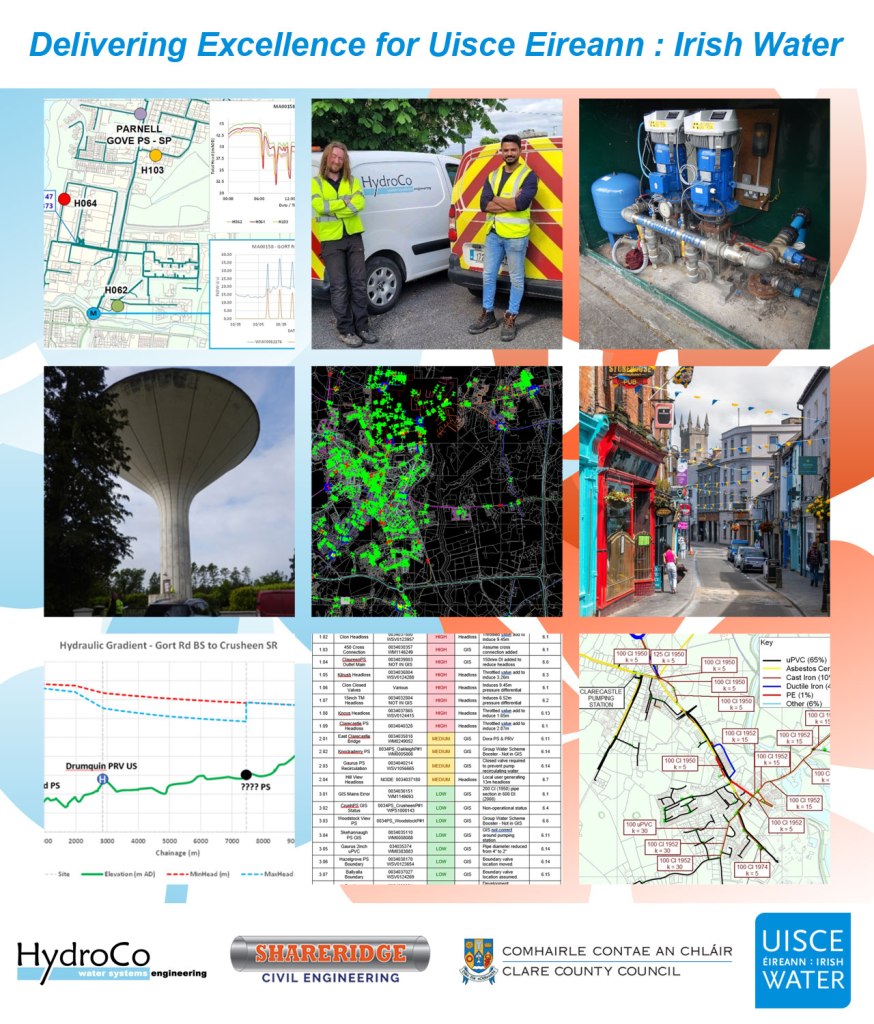
Following a successful framework bid in 2022, HydroCo & Shareridge formed a partnership to build hydraulic models on behalf of Uisce Eireann (Irish Water).

We are thrilled to announce that HydroCo and Shareridge have successfully delivered our first two hydraulic model build projects to Uisce Eireann. The feedback from the modelling team and local authority has been overwhelmingly positive, highlighting both models’ conformity, accuracy and ability to identify hydraulic anomalies.

The Ennis and Limerick Environs (Ardnacrusha) models should provide valuable insight into the operation of these systems, offering a holistic approach to system management, encompassing design, planning, performance evaluation, risk management, resource conservation, cost savings, and decision support.

A pivotal goal in constructing these models was to empower Uisce Eireann with the capability to evaluate pressure management schemes. This strategic optimisation of network configurations aims to achieve substantial leakage reduction, thereby enhancing water loss management and promoting resource conservation.

Our gratitude goes out to all stakeholders, particularly the dedicated operational personnel within Clare County Council, for their unwavering support throughout these challenging projects.

The synergy between HydroCo and Shareridge has been instrumental in the success of these projects. By combining HydroCo’s technical hydraulic modelling expertise with Shareridge’s proficiency in project management and field survey capabilities, we have not only delivered exceptional results but also bridged cultural divides.

Looking ahead, HydroCo and Shareridge are excited to continue our collaboration on six more hydraulic network model build projects across the South of Ireland. The models cover the city of Limerick, Waterford, Gory and South Regional areas in county Wexford and New and Old Doolough systems in West Clare.

Together, we remain committed to providing Uisce Eireann with high-quality, cost-effective modelling tools for sustainable water management.

If you would like to learn more about how HydroCo can support you with your hydraulic model builds, please contact us at innovation@hydroco.co.uk or call 023 92 450 007.

Supply Route Analysis

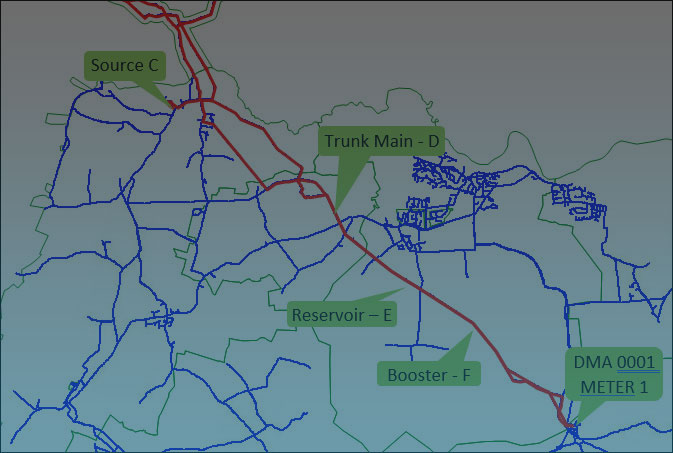
HydroCo was asked to identify and report on the percentage of water from the various sources in a large complex water supply and distribution system. The results were required at every DMA meter along with an overview of the typical routes water would take to reach that meter (e.g. Source via specific Trunk Main / Asset to Meter).

This would help the client in understanding the risk associated with the potential failure of individual / multiple water sources and / or Trunk Mains or Assets.

Ruby Scripting

InfoWorks WS PRO

Bespoke SQL Tools

Water Quality Modelling

The InfoWorks WS Pro software package was used for the analysis. A Water Quality model run of 45 days was found to be required to allow the model to trace the water from each source node through the entire model (trace water to fully saturate the model).  The model was setup dynamically so that a model run of such a length could be performed without problems (over/under filling of reservoirs etc.).

Each of the sources was set up as a “Trace” node in the model run settings.

A collaborative effort between HydroCo’s Principal Engineers and Hydraulic Modellers saw the creation of various SQLs and Ruby Scripts that would easily pull the relevant source percentage information from all specified model locations on mass, in a useable format.

Source-works Composition

Associate assets with key sources

Supporting PR24 Submission

District Meter Supply

The potential routes of water were then assessed, which was predominantly a manual process using the Infoworks upstream trace functions, though some time saving processes were developed to easily identify which trunk mains or assets were along the route.

This data was then cleansed and structured into a report that was clear and easy for the client to interpret.

If you would like to learn more about how HydroCo can support you with Supply Route Analysis, please contact us at innovation@hydroco.co.uk or call 023 92 450 007.